
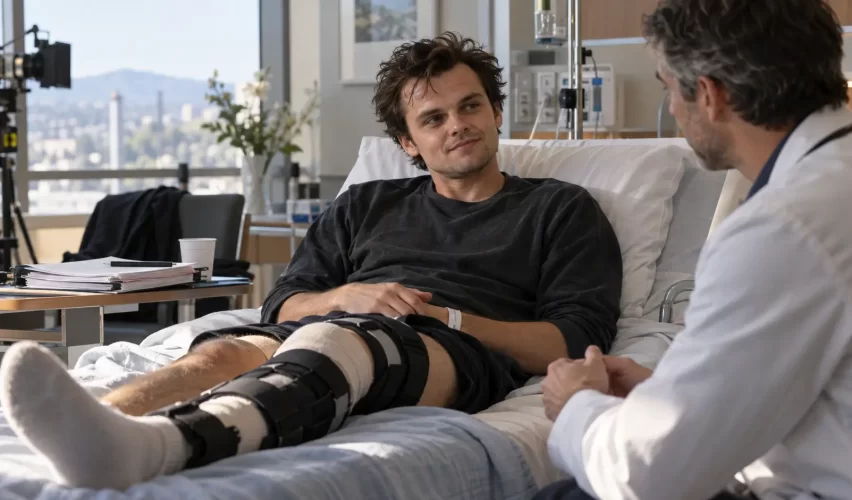
Ray Nicholson underwent knee surgery after suffering an injury while filming his new movie, The Mosquito Bowl. The actor revealed that he fell while running across a rock quarry during an action sequence, leaving a deep wound that required surgical treatment.
Despite undergoing an operation, Nicholson returned to filming the following day, even though he was still limping. The incident has gained attention as the World War II sports drama reaches theaters on October 30, 2026.
The actor’s experience highlights the physical demands of film production, the importance of evaluating deep wounds, and the challenges of returning to work after surgery.
What Happened to Ray Nicholson on The Mosquito Bowl Set?
According to People’s exclusive report on Ray Nicholson’s knee injury, the 34-year-old actor was filming a running sequence with costar Tom Francis when he fell on a rocky surface.
Nicholson was wearing knee pads during filming. Initially, he experienced an unusual numb sensation around his knee and did not immediately realize the extent of the injury.
Later, after rolling up his pant leg, he discovered a substantial wound that he described as resembling a crater.
The timing was particularly challenging because the cast was scheduled to film one of the movie’s most important scenes the following day.
During an October 22 interview at the film’s AFI Fest premiere, Nicholson explained that medical professionals cleaned out the wound during an operation. He subsequently returned to work despite walking with a limp.
Why Did Ray Nicholson Need Knee Surgery?
Nicholson’s account indicates that the injury involved a deep wound around his knee that required surgical cleaning and closure.
Just Jared’s coverage of the incident confirmed that the actor underwent an operation after the fall.
In another interview, Nicholson explained that surgeons cleaned the affected area and stitched the wound.
These details are important because knee surgery can refer to many different procedures.
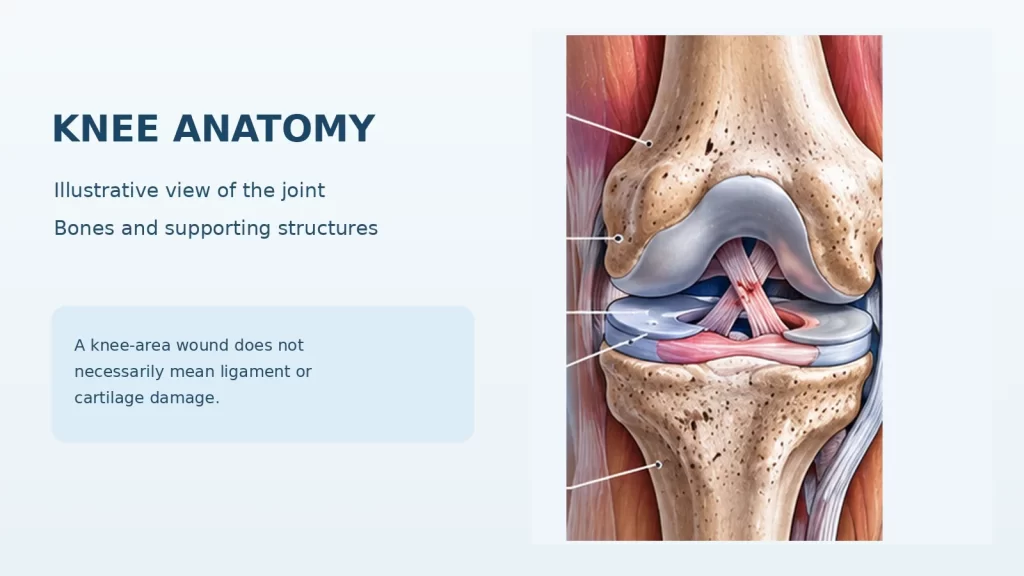
There is no public confirmation that Nicholson suffered a torn anterior cruciate ligament, meniscus damage, a fracture, or another internal joint injury.
His reported procedure should therefore be understood as treatment for a significant traumatic wound rather than an assumed ligament reconstruction or joint operation.
How Can a Fall Cause a Deep Knee Wound?
The knee sits near the surface of the body and is particularly vulnerable during falls, collisions, and contact with hard objects.
When someone falls onto a sharp or uneven surface, the impact can injure the skin and deeper soft tissues. Depending on the force and location, the resulting wound may extend beyond a superficial scrape.
The MedlinePlus guide to cuts and puncture wounds explains that deep injuries can affect muscles, ligaments, tendons, blood vessels, nerves, or other tissues.
However, not every deep-looking wound damages these structures.
Medical professionals evaluate the injury’s depth, location, contamination, and surrounding tissues to determine the appropriate treatment.
Why Cleaning a Deep Wound Matters
One of the most important steps in treating a contaminated wound is removing dirt, foreign materials, and damaged tissue when medically necessary.
Outdoor filming locations can contain rocks, soil, dust, and other materials that may contaminate an open injury.
According to Mayo Clinic’s wound care guidance, properly cleaning a wound helps reduce infection risks.
Medical professionals may use irrigation to flush away debris and examine the affected tissues before deciding whether stitches are appropriate.
In some situations, surgical cleaning is necessary when a wound is too extensive or contaminated for routine treatment.
Nicholson confirmed that his knee was cleaned during surgery, but the complete surgical findings have not been publicly disclosed.
Understanding the Risk of Infection
Deep wounds require careful attention because bacteria can enter damaged tissue, particularly when an injury occurs outdoors.
Signs of infection may include increasing redness, swelling, warmth, worsening pain, unusual drainage, or fever.
The Centers for Disease Control and Prevention also recommends assessing tetanus protection when treating injuries involving soil or other potentially contaminated materials.
Whether a patient needs a tetanus booster depends on the type of wound and vaccination history.
There is no public indication that Nicholson developed an infection or required treatment for tetanus. These are general medical considerations associated with traumatic wounds.
How Quickly Can Someone Recover After Knee Wound Surgery?
Recovery depends on the size, depth, and location of the injury, along with the procedure performed.
For wounds closed with stitches, patients usually receive instructions about protecting the area, keeping dressings clean, limiting certain movements, and attending follow-up appointments.
The MedlinePlus guide to surgical wound care explains that protecting the incision can help reduce infection risks and support healing.
Movement restrictions may be especially relevant when a wound is located near a joint that bends frequently.
Nicholson returned to filming the day after his operation, but this does not establish that the wound had fully healed.
His personal experience should not be used as a general recovery timetable for people who undergo similar procedures.
Ray Nicholson Returned to Filming While Limping
One of the most surprising aspects of the story is how quickly Nicholson resumed work.
He revealed that he returned to the set the day after surgery, even though the injury affected his ability to walk normally.
The actor explained that he felt a strong responsibility to complete his role and honor the real-life Marines portrayed in the film.
However, returning to work after surgery requires individualized medical guidance. Depending on the injury, patients may be advised to limit strenuous movements or activities that place tension on healing tissues.
For broader context, Celeb Injuries explores rehabilitation and returning to professional commitments in Surgeries and Recovery: How Celebrities Bounce Back from Major Injuries.
What Is The Mosquito Bowl About?
The Mosquito Bowl is a World War II drama directed by Peter Berg and based on Buzz Bissinger’s nonfiction book of the same name.
The story follows four college football players who enlist in the United States Marine Corps after the attack on Pearl Harbor.
Nicholson portrays Tony Butkovich, alongside Nicholas Galitzine, Bill Skarsgård, and Tom Francis.
The film draws inspiration from a football game played between Marine regiments on Guadalcanal in December 1944.
According to Netflix’s official coverage of The Mosquito Bowl, the production explores the experiences of young athletes confronting the realities of war.
The movie opens in select theaters on October 30, 2026, and is scheduled to arrive on Netflix on November 25.
The Physical Demands of Filming a War Movie
War films often require physically demanding performances involving running, crawling, uneven terrain, military equipment, and simulated combat.
Actors may also undergo specialized training to make their movements more realistic.
For The Mosquito Bowl, the cast trained alongside professional football players and Marines while preparing for their roles.
These activities can require considerable strength, coordination, endurance, and awareness of the surrounding environment.
Even with protective equipment, unexpected falls can occur.
Nicholson’s injury illustrates how a relatively brief incident during a running sequence can interrupt filming and require medical treatment.
Why Protective Knee Pads Do Not Prevent Every Injury
Knee pads are commonly used to reduce direct impact during activities involving kneeling, falls, or contact with rough surfaces.
However, protective equipment has limitations. Its effectiveness depends on factors such as fit, coverage, movement, impact direction, and the surface involved.
Rocky environments can contain uneven or protruding objects that create hazards during fast movements.
Nicholson reported wearing knee pads when he fell, but the precise interaction between the protective equipment and the surface has not been publicly documented.
His experience demonstrates why protective equipment should be combined with appropriate planning, rehearsals, and hazard assessments.
How Film Productions Can Reduce Stunt-Related Injuries
Complex physical scenes require coordination among performers, directors, stunt professionals, and production crews.
The Contract Services motion picture safety bulletins include recommended practices for managing stunt risks.
These guidelines encourage safety meetings, rehearsals, equipment inspections, communication, and consideration of environmental hazards.
For scenes involving rocky terrain, important considerations may include surface stability, obstacles, footwear, protective equipment, and emergency response arrangements.
The guidelines are recommendations rather than binding laws. Applicable safety regulations may impose additional requirements.
Readers can also explore On-Set Safety Protocols: How Hollywood Protects Its Stars During Filming for more information about production safety planning.
The Importance of Reporting Injuries Immediately
When an injury occurs during filming, promptly informing appropriate personnel allows the production to arrange medical evaluation and assess whether the working environment needs adjustment.
Even when symptoms initially seem minor, an injury may require further examination.
In Nicholson’s case, the initial numb sensation did not immediately reveal the severity of the wound.
Reporting injuries also helps productions document incidents and evaluate whether additional safety precautions may be necessary.
Celeb Injuries examines these issues in Stunt Double vs. Celebrity Injury Liability: Who’s Responsible When Action Goes Wrong?.
Physical Rehabilitation After a Knee Injury
Some knee-area injuries require rehabilitation to restore comfort, mobility, and confidence during movement.
Depending on the severity and location of the injury, treatment may focus on gradually increasing activity, improving movement, or addressing weakness caused by temporary restrictions.
However, not every patient recovering from a stitched wound requires formal physical therapy.
There is no public confirmation that Nicholson completed a particular rehabilitation program after his operation.
The need for therapy depends on the patient’s clinical findings and the treating professional’s recommendations.
Can Returning to Work Too Soon Affect Wound Healing?
Returning to physically demanding activity before a wound has healed sufficiently may increase tension on its closure, depending on the injury and treatment.
MedlinePlus guidance for lacerations closed with stitches advises patients to follow activity restrictions and seek medical attention if a wound reopens or develops concerning symptoms.
The appropriate timing for returning to work varies considerably.
Nicholson’s return to filming was his individual experience and should not be interpreted as a recommendation to resume strenuous activity immediately after surgery.
Why Ray Nicholson’s Injury Story Matters
Film audiences generally see the finished action sequence rather than the rehearsals, medical evaluations, and production adjustments behind it.
Nicholson’s account provides a glimpse of how physically demanding filmmaking can become, even when performers wear protective equipment.
It also highlights the importance of distinguishing a deep soft-tissue wound from injuries involving the internal structures of the knee.
Responsible reporting should avoid assigning unconfirmed diagnoses or suggesting that an actor’s return to work proves complete recovery.
Final Thoughts
Ray Nicholson’s knee injury during The Mosquito Bowl demonstrates how quickly an accident on a film set can require surgical treatment.
The actor fell while running across a rock quarry, underwent an operation to clean and close the wound, and returned to filming the following day despite limping.
His experience highlights the importance of prompt medical evaluation, appropriate wound care, protective equipment, and careful planning during physically demanding productions.
For more celebrity injuries involving action scenes and movie productions, explore Celeb Injuries’ On-Set Injury coverage.