
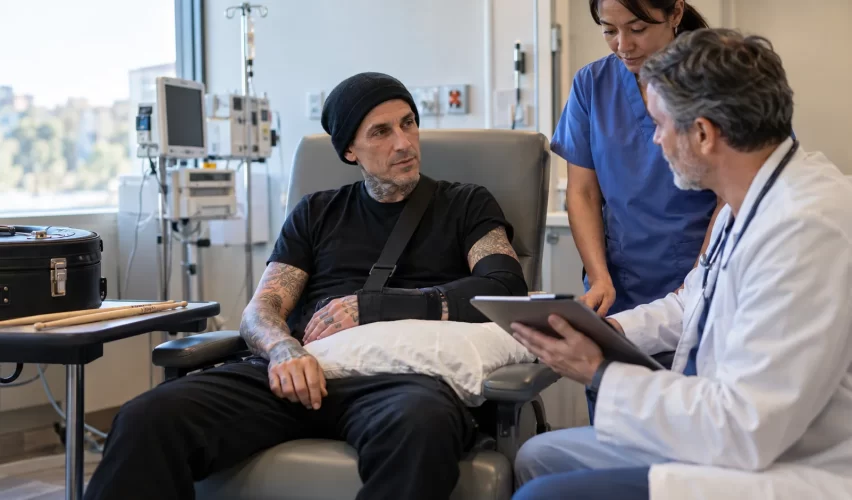
Travis Barker has revealed that he underwent nerve surgery after experiencing persistent numbness in his arm, hand, and fingers. The Blink-182 drummer explained that the symptoms continued for weeks following a concert performance, eventually leading doctors to recommend a procedure known as cubital tunnel release.
The health update has attracted attention because Barker’s hands are essential to his career. Known for fast, physically demanding drumming, the musician depends on coordination, grip strength, precise timing, and reliable sensation to perform.
On October 7, 2026, Barker shared details about the procedure after posting hospital photographs with his wife, Kourtney Kardashian, and daughter Alabama Barker. His experience highlights an often-overlooked occupational concern: nerve compression can affect musicians and other professionals whose work involves repetitive arm and hand movements.
What Happened to Travis Barker?
According to People’s report on Travis Barker’s surgery, the 50-year-old musician disclosed that his arm, hand, and fingers had felt numb since a performance the previous month.
Barker said he underwent a nerve test on Monday, October 5, after another show. The results indicated that he needed a cubital tunnel release to address the problem.
He underwent surgery on October 6 and subsequently explained that he wanted to address the condition before it affected his ability to continue performing over the long term.
E! News also reported that Barker expected to be doing well within a few weeks. That estimate reflects his personal recovery expectations, not a guaranteed timeline for complete nerve healing.
What Is Cubital Tunnel Syndrome?
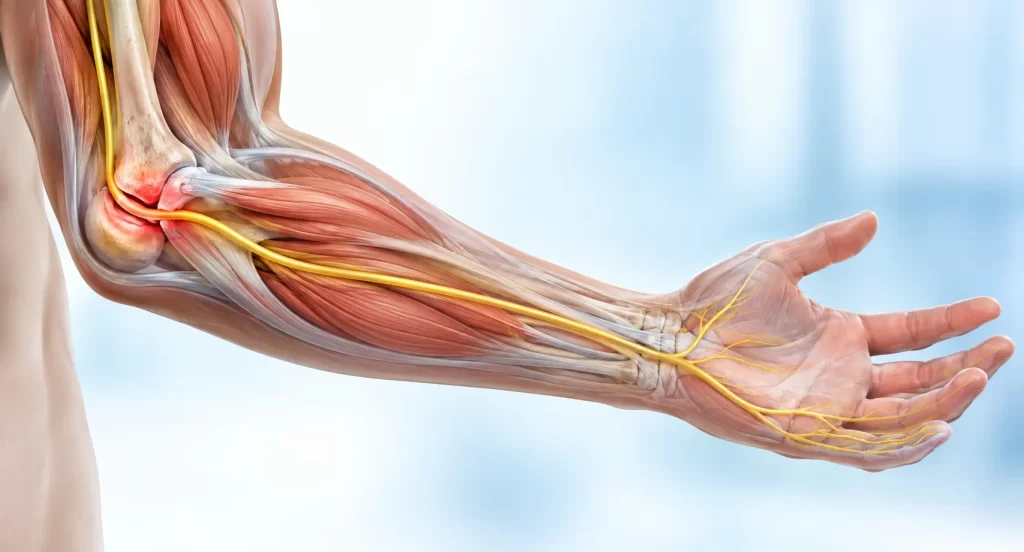
Cubital tunnel syndrome is a condition involving compression or irritation of the ulnar nerve near the elbow. The ulnar nerve runs from the neck through the arm and provides sensation to portions of the hand, particularly the little finger and part of the ring finger.
It also controls muscles involved in precise finger movements and gripping objects.
The American Academy of Orthopaedic Surgeons explains that this nerve travels through a narrow passage around the inner elbow called the cubital tunnel.
When the nerve becomes compressed or irritated, patients may experience tingling, numbness, discomfort, or weakness. Symptoms can be especially noticeable when the elbow remains bent for extended periods.
Why Hand Numbness Can Be Serious for a Drummer
Playing the drums requires precise interaction between the hands, wrists, forearms, elbows, and shoulders. A drummer must repeatedly control stick movement while maintaining timing and responding to rapid changes in rhythm.
Reduced sensation can make it harder to judge grip pressure or maintain consistent control. Weakness involving the smaller muscles of the hand can also interfere with delicate movements.
Barker’s style is particularly energetic, combining fast rhythms with forceful arm movements and extended live performances.
However, there is no public confirmation that drumming directly caused his nerve compression. Repetitive movement and prolonged elbow positioning are recognized risk factors, but determining the cause of an individual case requires medical evaluation.
How Doctors Diagnose Ulnar Nerve Problems
Numbness in the arm or hand can have several possible causes. Problems involving the neck, elbow, wrist, or peripheral nerves may produce overlapping symptoms.
A medical evaluation may include checking strength, sensation, finger coordination, and areas of tenderness around the elbow.
Doctors can also recommend electrodiagnostic testing, including nerve conduction studies or electromyography, to assess nerve function.
The Cleveland Clinic’s cubital tunnel syndrome guide explains that testing can help determine whether the ulnar nerve is affected and evaluate the severity of compression.
Barker disclosed that a nerve test preceded his operation, but he has not publicly released the results or detailed findings from that examination.
What Happens During Cubital Tunnel Release Surgery?
Cubital tunnel release is designed to create more space for the ulnar nerve as it passes around the elbow.
According to the AAOS guide to cubital tunnel release surgery, surgeons typically release a band of tissue forming the roof of the cubital tunnel. This reduces pressure on the nerve.
In some cases, a different procedure called ulnar nerve transposition is recommended to reposition the nerve. The appropriate technique depends on the patient’s anatomy and clinical findings.
Barker specifically identified his operation as a cubital tunnel release. He has not publicly described additional procedures or technical details of his surgery.
The objective is to relieve compression, reduce symptoms when possible, and help prevent further deterioration in nerve function.
How Long Does Recovery Take?
Recovery from nerve surgery can involve several stages. The surgical incision may heal relatively quickly, while irritated nerve tissue may need substantially more time to recover.
The AAOS notes that people with less physically demanding jobs may sometimes return to work within days after a straightforward procedure. Workers performing heavy or repetitive manual activity may need longer restrictions.
Importantly, improvement in numbness or hand strength does not always follow the same timeline as wound healing. The AAOS explains that final nerve recovery can sometimes take many months.
Barker’s expectation of feeling better within a few weeks should therefore be understood as his personal update rather than a universal medical recovery estimate.
Hand Rehabilitation and Returning to Performance
After cubital tunnel surgery, medical teams may recommend controlled movement, temporary restrictions, and rehabilitation depending on the procedure and symptoms.
Some patients work with a hand therapist or occupational therapist to improve movement, strength, coordination, and tolerance for everyday activities.
For a professional drummer, rehabilitation may eventually need to address endurance and fine motor control in addition to basic hand function.
Exercises should follow instructions from the treating surgeon. Starting strenuous gripping or repetitive movements before receiving clearance can place unnecessary stress on recovering tissues.
Why Barker Wanted to Address the Problem Early
Barker said he wanted to get ahead of the condition so he could continue performing the way he plays for years to come.
His reasoning reflects an important distinction between temporarily managing symptoms and protecting long-term function.
The AAOS notes that earlier treatment can improve the outlook for certain patients. When nerve compression becomes severe enough to cause lasting muscle loss, surgery may prevent worsening without fully reversing existing damage.
That does not mean Barker had permanent nerve damage. His statement did not establish muscle wasting or another specific complication.
Instead, he described choosing treatment after testing identified an issue requiring attention.
Is This Related to Barker’s Previous Finger Injury?
Barker underwent surgery in 2023 after injuring a finger during Blink-182 rehearsals. That earlier injury reportedly involved a torn ligament.
The two conditions are medically different. A torn finger ligament involves tissue that stabilizes a joint, while cubital tunnel syndrome affects the ulnar nerve around the elbow.
There is no publicly established medical connection between Barker’s earlier finger injury and his October 2026 nerve procedure.
Nevertheless, both incidents illustrate how injuries involving the upper extremities can become significant career concerns for professional musicians.
More broadly, Celeb Injuries has explored surgeries and rehabilitation after major celebrity injuries.
How Performers Can Manage Repetitive Strain
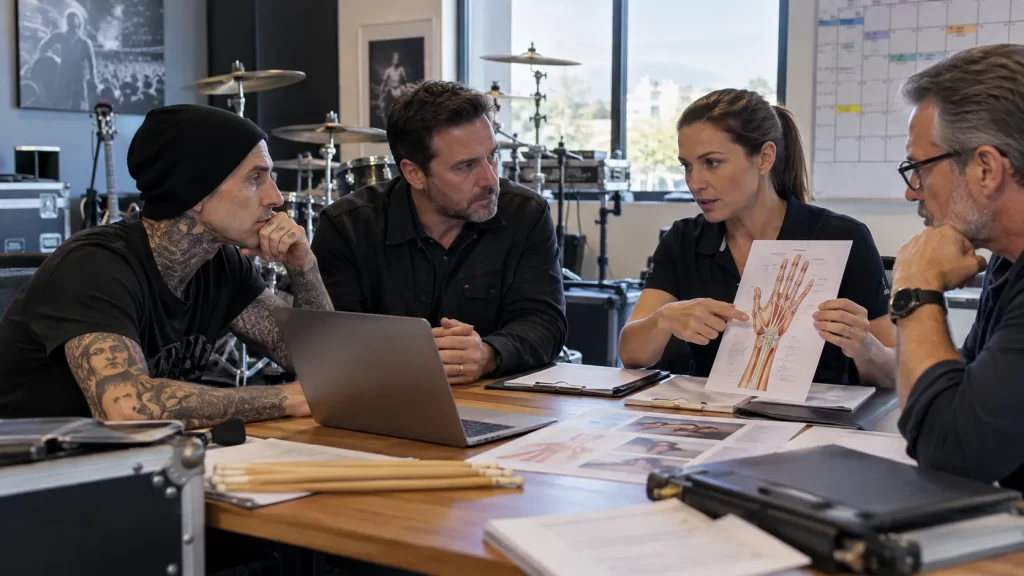
Musicians sometimes benefit from identifying movements or working conditions that aggravate symptoms. Depending on the problem, professional recommendations may include adjusted technique, improved ergonomics, appropriate rest periods, or temporary activity restrictions.
For people with cubital tunnel syndrome, the AAOS describes nonsurgical options such as reducing prolonged elbow bending, avoiding pressure on the elbow, and using certain nighttime braces when recommended.
These measures are not substitutes for individualized treatment and may not be sufficient when compression is severe.
The occupational challenges facing performers are discussed in Celeb Injuries’ guide to the hidden dangers of live performances.
Could the Surgery Affect Blink-182’s Performances?
Barker’s surgery naturally raises questions about future concerts, rehearsals, and recording sessions.
Drumming can involve repeated gripping, elbow movement, and sustained upper-body activity. A physician may recommend temporarily limiting such activities while the surgical area heals.
However, Barker has not announced a universal restriction affecting every future performance, and his medical clearance details remain private.
Tour planners can respond to a performer’s recovery needs by reviewing rehearsal intensity, rest periods, recording schedules, and possible contingency arrangements.
The Importance of Medical Privacy
Barker voluntarily shared the reason for his hospitalization, but he has not disclosed every aspect of his diagnosis or treatment.
Responsible coverage should avoid assuming a particular degree of nerve damage, assigning an unconfirmed cause, or predicting exactly how his playing ability will change.
His willingness to discuss the procedure can increase awareness of nerve compression without turning his personal medical situation into a diagnosis for other musicians.
Final Thoughts
Travis Barker’s October 2026 nerve surgery highlights the importance of protecting hand and arm function in physically demanding creative careers.
The Blink-182 drummer underwent cubital tunnel release after experiencing persistent numbness and receiving results from a nerve test. He has expressed optimism about his recovery and his ability to continue performing.
His experience also provides a broader reminder that persistent numbness, tingling, or weakness deserves appropriate medical evaluation, particularly when those symptoms interfere with work or everyday activities.
For more updates on performers managing injuries and medical treatment, visit Celeb Injuries’ Celebrity Injury and Celebrity Recovery sections.