
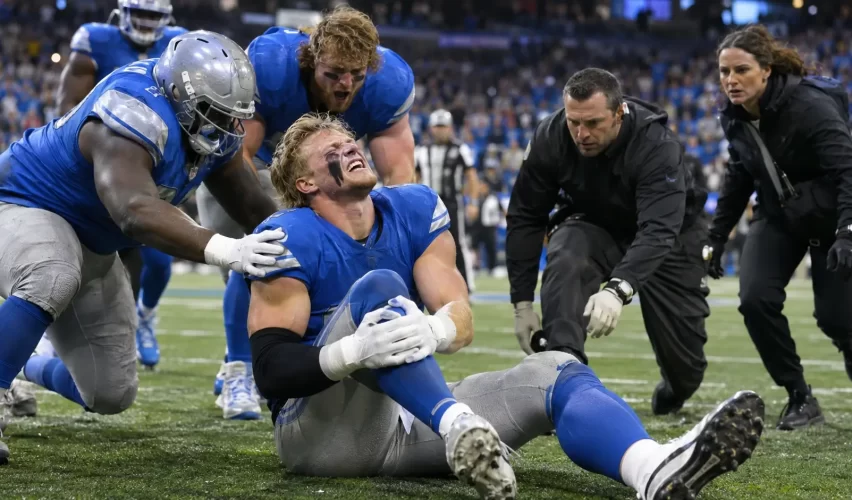
Aidan Hutchinson’s ACL tear has ended the Detroit Lions defensive end’s 2026 NFL season after a sudden injury during a sack celebration. On November 15, Hutchinson jumped after sacking New England Patriots quarterback Drake Maye, then collapsed when he landed during the Lions’ game in Munich, Germany.
The Lions confirmed on November 17 that Hutchinson tore the anterior cruciate ligament in his right knee and would need surgery. His injury attracted attention because it happened during a celebration rather than a tackle, raising questions about how ACL tears occur and what a return to professional football might involve.
How Did Aidan Hutchinson Injure His Knee?
According to the Detroit Lions’ official update, Hutchinson was injured in the first quarter of the team’s November 15 win over New England. He made a third-down sack and jumped to celebrate before his right knee appeared to buckle on landing.
The incident occurred at Allianz Arena in Munich, where Detroit defeated the Patriots 35-10. Hutchinson was assessed by team medical personnel and did not return to the game.
NFL.com reported that initial testing identified the ACL tear. His team subsequently confirmed the diagnosis and said surgery would end his season. The precise surgery date and any other injured structures had not been finalized in that announcement.
Why Can a Jump Landing Cause an ACL Tear?
The ACL is one of the major ligaments that stabilizes the knee, helping control movement between the thighbone and shinbone. It can be injured when the knee experiences sudden rotational or forward-moving forces.
The Mayo Clinic’s explanation of ACL injuries lists awkward jump landings, abrupt stops, and changes in direction among common mechanisms. An ACL tear can therefore occur without direct contact from another player.
That distinction matters in Hutchinson’s case. The reported injury happened during the celebration after his sack, not during a confirmed collision to his knee. Video and reports can establish the timing, but a medical evaluation is needed to assess the full structural damage.
What Is the Anterior Cruciate Ligament?
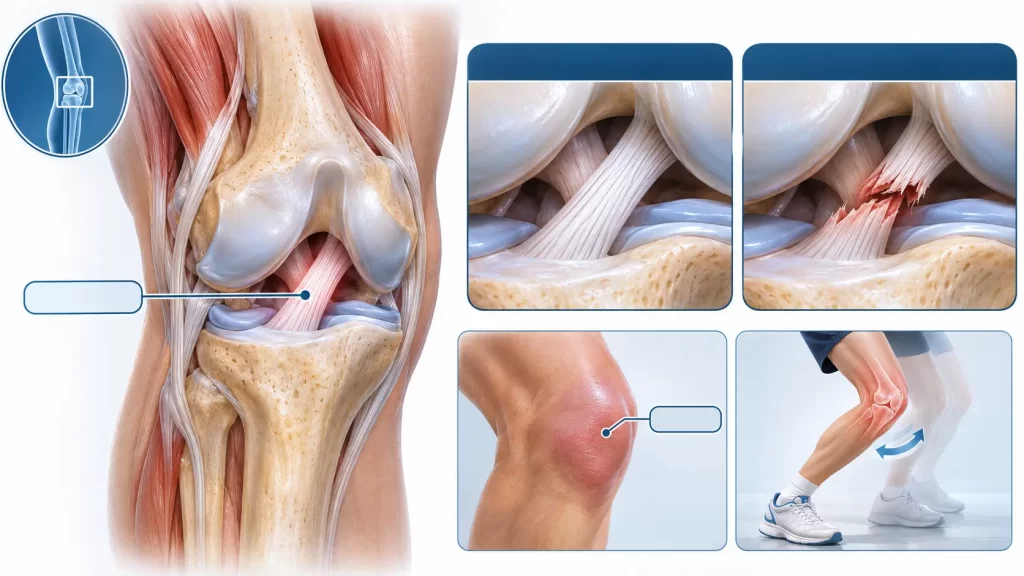
The ACL crosses the center of the knee joint and works alongside the posterior cruciate ligament, collateral ligaments, cartilage, and surrounding muscles. Together, these structures allow the knee to support body weight while maintaining stability during movement.
The American Academy of Orthopedic Surgeons describes ACL injuries ranging from partial tears to complete ruptures. A severe tear can leave a person feeling that the knee may give way during twisting or pivoting.
Signs can include swelling, pain, reduced range of motion, and difficulty bearing weight. However, symptom intensity alone does not determine the exact grade of damage or whether other parts of the knee were injured.
Why Is the Injury Season-Ending?
Professional football requires sprinting, explosive direction changes, powerful leg drive, and contact with other players. A damaged ACL may compromise the stability needed for those movements, particularly during high-intensity cutting and pivoting.
Lions head coach Dan Campbell confirmed that Hutchinson would need surgery and would miss the remainder of the 2026 season. He expressed confidence in the player’s ability to work through rehabilitation, while acknowledging the major loss to the team.
It’s important not to convert that optimism into a promised return date. The team’s statement confirmed a season-ending injury, not a guaranteed timetable for resuming NFL games.
How Do Doctors Confirm an ACL Tear?
Clinicians assess the history of injury, knee swelling, joint movement, and stability. Physical examination maneuvers can help identify abnormal movement between the lower leg and thighbone.
MRI scans may help visualize the ACL and other soft tissues. AAOS patient guidance explains that ACL tears can occur together with injuries affecting the meniscus, cartilage, or other ligaments.
Initial reports suggested the possibility of additional knee damage in Hutchinson’s case, and Campbell said more would be known after surgery. Such possibilities should not be reported as confirmed meniscus or cartilage diagnoses unless the team releases the findings.
What Does ACL Reconstruction Involve?
When surgery is recommended for a torn ACL, surgeons often reconstruct the ligament using a tendon graft. The graft replaces the damaged ligament and provides a structure that can gradually become incorporated into the knee during healing.
The surgical plan depends on the patient, associated injuries, and the orthopedic team’s judgment. Not every ACL tear requires reconstruction, but complete tears in athletes who need strong rotational stability often warrant operative treatment.
Hutchinson’s team has said surgery is necessary. The specific graft source, surgical technique, and whether additional procedures will be required have not been publicly confirmed.
How Long Does Recovery Usually Take?
ACL rehabilitation is measured in months rather than days. Early recovery may focus on reducing swelling, restoring comfortable knee movement, and rebuilding muscle activation. Later stages usually involve strengthening, balance, running and sport-specific movement.
AAOS notes that many patients return to full sports participation within roughly six to twelve months, depending on healing, functional progress and the demands of the activity. High-level professional sports can require more detailed testing.
That broad medical range is not a specific forecast for Hutchinson. His actual return will depend on surgery findings, rehabilitation progress, and clearance from his clinical and team staff.
What Does Knee Rehabilitation Look Like?
After surgery, physical therapy may begin with gentle knee extension, controlled movement, and exercises to activate the quadriceps. A patient may use crutches or a brace depending on medical instructions and associated injuries.
The MedlinePlus ACL reconstruction discharge guide explains that early activity restrictions and home care should follow the surgeon’s directions. Progressing too quickly can be problematic, especially if additional knee structures were repaired.
Later rehabilitation may introduce exercises targeting strength, endurance, balance, and efficient landing mechanics. The goal for an elite defensive player is not merely walking comfortably but meeting demanding benchmarks for acceleration, cutting, contact readiness, and repeated explosive movement.
Why Is Return-to-Play Testing Important?
Feeling better is not the same as being ready for competition. Physical therapists, orthopedic specialists, and athletic trainers may assess range of motion, swelling, leg strength, hopping or landing control, and confidence during complex movements.
AAOS advises considering multiple functional measures when deciding whether a patient can safely resume sports. A return made before adequate recovery may increase the risk of reinjury or problems involving other parts of the knee.
In the context of the NFL, any evaluation must also consider repeated changes of direction, collisions, and the force generated by large athletes. Nothing published so far establishes Hutchinson’s eventual test results or return-to-play clearance.
How Does This Compare With His Earlier Leg Injury?
Hutchinson has faced a major lower-body setback before. He fractured his left leg during the 2024 season, underwent surgery, and returned to produce a strong 2025 campaign.
The new injury is different: the 2026 diagnosis involves the ACL in his right knee, not the previously injured left leg. An earlier successful comeback is encouraging context but does not tell us how his current knee will heal.
Celeb Injuries has examined other professional athletes facing long rehabilitation, including Tiger Woods’ Achilles surgery and the broader challenges of returning after major celebrity injuries.
Did the Lions Change Their Celebration Policy?
In interviews following the injury, Campbell said he did not plan to impose a teamwide ban on celebrations. He acknowledged the unusual nature of the incident and declined to frame the event as a reason to prohibit players from expressing excitement.
The Associated Press noted that other professional athletes have suffered injuries during celebrations, but these cases are unusual relative to the many routine celebrations seen in sports.
Hutchinson also addressed the episode publicly on November 20, joking that it would be the last time he went airborne during a celebration. CBS Detroit reported his comments.
Can Better Landing Mechanics Reduce ACL Risk?
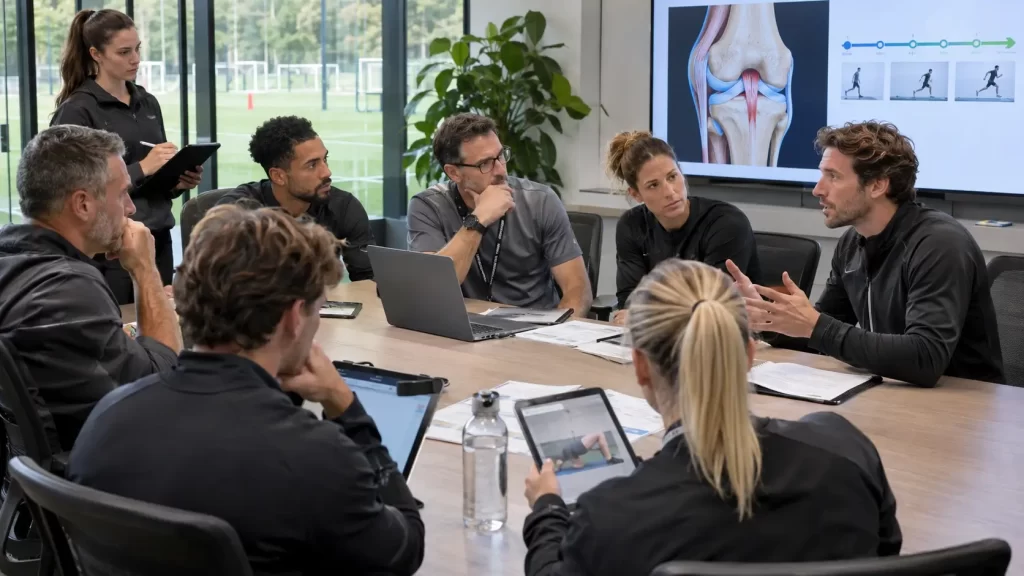
Sports medicine programs often emphasize lower-body strength, trunk stability, and controlled landing mechanics. Learning to absorb impact with the hips and knees aligned can help reduce stress during jumping and rapid changes of direction.
The Mayo Clinic describes prevention programs that combine strengthening, balance, and improved movement technique. No training method can prevent every ACL tear, especially in unpredictable competitive conditions.
There is no evidence that a particular deficiency in Hutchinson’s training caused his injury. General prevention advice should not be used to assign blame for a single player’s landing.
What Does the Injury Mean for the Lions?
Hutchinson is an important Detroit pass rusher, and losing him for the remainder of the season affects defensive rotations and game planning. Campbell said the roster would need several players to help replace his impact.
That team consequence is separate from Hutchinson’s individual medical recovery. The organization’s immediate goal is continuing its season, while the player’s longer-term priority is the treatment and rehabilitation of his knee.
The site has explored other incidents where sudden injuries interrupted professional schedules, such as Frankie Muniz’s Daytona crash and medical evaluation and Julia Stiles’ dance rehearsal injury.
Final Thoughts
Aidan Hutchinson’s ACL tear shows how a noncontact landing can produce a major knee injury even after a successful football play. The Lions confirmed he needs season-ending surgery following the November 15 incident in Munich.
His recovery will require individualized orthopedic care and rehabilitation, with no guaranteed timetable for a return to NFL action. For more coverage of high-profile physical injuries, visit Celeb Injuries’ Celebrity Injury and Recovery & Rehabilitation sections.