

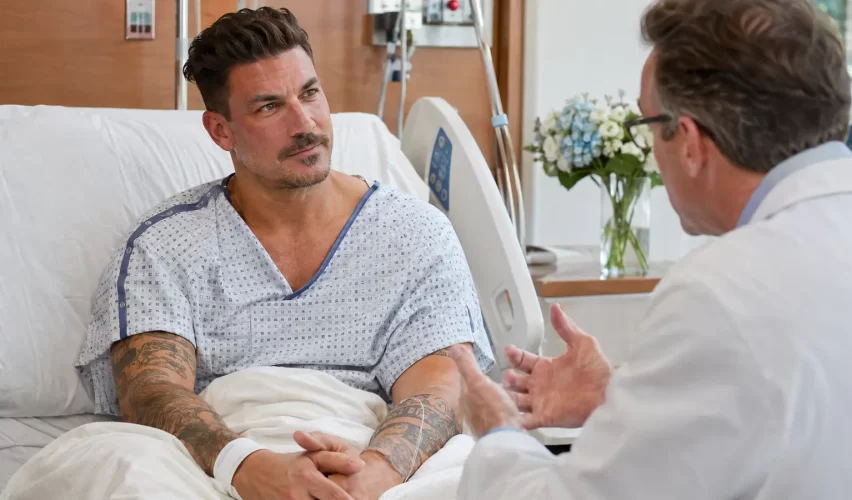
Jax Taylor kidney cancer surgery became a major celebrity health story in November 2026 when the former Vanderpump Rules cast member revealed that a scan for kidney stones had uncovered a tumor in his left kidney. Taylor, 47, said surgeons removed the tumor during a five-hour procedure and that he was awaiting the final pathology report.
On November 20, Taylor provided more precise details: his operation was a robotic-assisted left partial nephrectomy, and he described the 4.1-centimeter tumor as clinical stage I (T1b) kidney cancer. His experience brings attention to how some kidney tumors are detected unexpectedly, what kidney-sparing surgery involves, and why recovery updates are not the same as final cancer results.
What Did Jax Taylor Reveal About His Diagnosis?
In a November 19 report, the Los Angeles Times described Taylor’s account of months spent processing a diagnosis he had kept largely private. He said severe pain led him to a hospital in July, where doctors identified kidney stones and also noticed a mass on a CT scan.
Additional appointments and testing followed. Taylor publicly said the mass was cancerous and recalled how difficult the uncertainty felt, especially because his father had died of cancer. These are details Taylor shared himself, not an independent release of his entire medical record.
He also credited people close to him for support during the evaluation and surgery. Nothing about his experience means every kidney stone patient has cancer; the imaging simply created an opportunity to identify a second, unrelated concern.
How Was the Kidney Tumor Discovered?
Kidney stones can produce sudden, intense pain and lead to imaging of the urinary tract. Those scans sometimes reveal an incidental finding: a condition discovered while doctors are investigating something else. An unexpected kidney mass may then require further imaging, specialist assessment, or other diagnostic work.
The National Cancer Institute’s patient guide to renal cell cancer explains that CT scans and other studies help doctors examine kidney tumors and assess the extent of disease. It is not possible to determine from an image alone whether every renal mass is cancer.
Taylor said doctors diagnosed cancer after additional tests, but he has not publicly disclosed all the imaging or laboratory findings. His reported discovery illustrates the value of following up on unexpected findings rather than ignoring them after an initial emergency has passed.
What Does Clinical Stage I, T1b Kidney Cancer Mean?
Taylor identified his tumor as 4.1 centimeters and described the clinical stage as I, or T1b. In kidney cancer staging, T1b generally refers to a tumor larger than four centimeters but no larger than seven centimeters that is limited to the kidney. Stage I additionally requires no evidence of regional lymph-node or distant spread in the applicable staging assessment.
The National Cancer Institute’s stage definitions distinguish clinical staging, based on examinations and tests before definitive tissue review, from later pathologic findings. Taylor has not released final pathology results or confirmed surgical margins.
For that reason, it would be premature to describe the operation as a confirmed cure, announce a final pathologic stage, or say the tumor had spread. A description of clinical stage I provides important context, but it does not replace the complete postoperative report.
What Is a Robotic-Assisted Partial Nephrectomy?
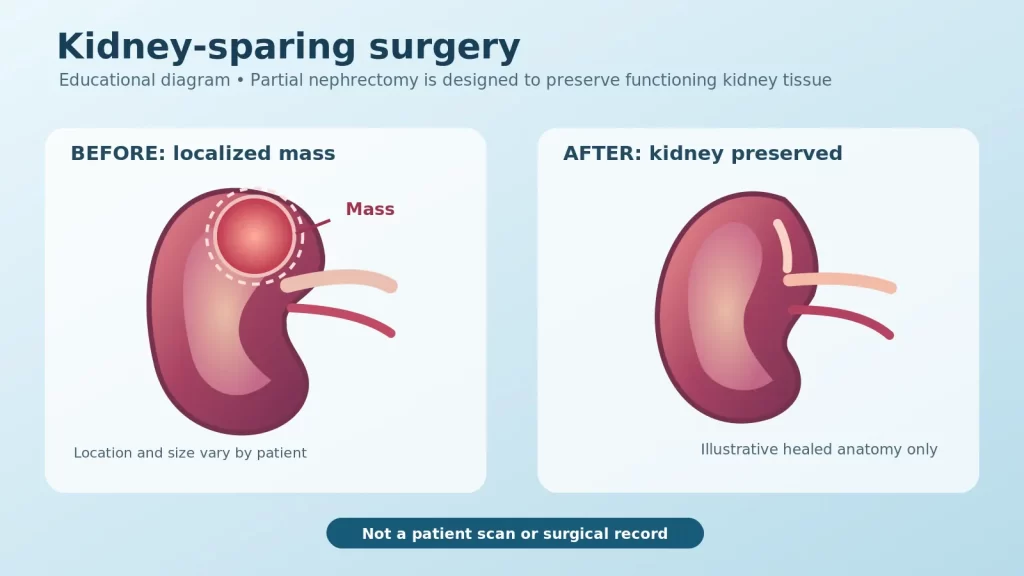
A partial nephrectomy is an operation that removes a kidney tumor and a margin of surrounding tissue while preserving as much functioning kidney tissue as medically appropriate. By contrast, a radical nephrectomy removes the entire kidney, sometimes with additional tissue depending on the case.
Robotic assistance allows a surgeon to control specialized instruments through small incisions, though the actual operation is performed by the surgical team rather than an autonomous robot. The approach chosen depends on the tumor’s position, size, medical history, and the team’s judgment.
The NCI lists partial nephrectomy among established treatments for selected patients with localized kidney cancer. Taylor specifically reported this procedure, but not his incision pattern, reconstruction technique, or whether any unusual surgical findings occurred.
Why Try to Preserve Part of the Kidney?
The kidneys filter waste products from the blood, regulate fluid balance, and participate in several other essential body functions. Preserving healthy kidney tissue can help protect kidney function, particularly when a person may face future medical issues or already has reduced function.
The National Cancer Institute’s kidney cancer treatment overview describes how kidney-sparing surgery has become an important option in appropriately selected localized cases. It does not mean everyone is a candidate for this operation or that it carries no risks.
Surgery still involves anesthesia, bleeding, and infection risks, along with the possibility of urine leakage or changes in kidney function. Patients should receive guidance suited to their individual condition and medical team.
What Happens After a Kidney Tumor Is Removed?
The excised tissue is typically examined by a pathologist to determine characteristics such as the tumor type, grade, and whether cancer cells extend to the cut edge, called the surgical margin. These details can affect decisions about surveillance and any additional treatment.
In his November 20 recovery update reported by Us Weekly, Taylor said he was waiting for his pathology report and hoped it would confirm that the margins were clear. A result had not yet been publicly established in that update.
It is therefore essential to distinguish an operation that removed a visible tumor from confirmation that all cancer was removed. Follow-up recommendations depend on the final findings and the treating clinician’s assessment.

Why Were There Reports of Postoperative Complications?
E! News reported on November 20 that a source close to Taylor said some postoperative complications had delayed his hospital discharge. The report did not identify a specific medical complication.
Later reporting of Taylor’s own November 20 update described him heading home after surgery. Those accounts should be read in sequence rather than treated as contradictory proof of a persistent emergency.
Because no precise complication has been confirmed publicly, it would be inaccurate to claim that he had infection, kidney failure, significant bleeding or another specific problem. General risks are different from an individually diagnosed postoperative complication.

What Can Recovery From a Partial Nephrectomy Involve?
Recovery often includes protecting the incisions, gradual walking, pain control, hydration guidance, and restrictions on heavy lifting or strenuous activity. The timetable varies with the surgical approach, the patient’s health, and any complications.
The Cleveland Clinic’s partial nephrectomy information explains that kidney surgery requires postoperative monitoring and follow-up. Its discussion of open surgery should not be mistaken for the precise recovery instructions after Taylor’s reported robotic-assisted operation.
Patients may also need blood tests to check kidney function and postoperative visits to review the pathology report. Specific medications, activity limits, and future testing schedules should come from the treating team.
Could Jax Taylor Need Additional Cancer Treatment?
That question cannot be answered from his posts alone. Treatment after surgery depends on the final tumor type, pathologic stage, surgical margins, overall health, and other clinical factors. Some patients with localized kidney cancer undergo surveillance after surgery without immediate additional therapy.
The NCI outlines treatment and follow-up options based on cancer stage and individual circumstances. No confirmed public update establishes that Taylor needs chemotherapy, immunotherapy, radiation, or another procedure.
He has also not announced a final cancer-free status. As with all celebrity medical news, reporting should wait for a new statement rather than filling gaps with predictions.

The Emotional Side of an Unexpected Diagnosis
Taylor said the wait between discovering the kidney mass and learning more about the diagnosis was especially difficult. He connected those feelings to the loss of his father, explaining why the news carried personal weight for him.
Health scares may affect sleep, concentration, family routines and decisions about work, but it would be inappropriate to assign a mental health diagnosis without evidence. Support from family, trusted friends and qualified clinicians can be important during an uncertain treatment process.
Celeb Injuries has explored the broader effects of major health setbacks in its guide to celebrity surgeries and recovery and its Celebrity Health Scares coverage.

Could the Surgery Affect His Television Career?
Recovery from surgery can temporarily affect travel, filming, interviews, and other commitments. Reality television production often requires lengthy days, repeated scenes, and public appearances, which may need adjustment if a participant has medical restrictions.
However, Taylor has not publicly outlined a precise return-to-work schedule following his operation. His health update should not be used to invent a canceled project, confirmed leave period, or contractual dispute.
For a different example of how performers approach orthopedic surgery before returning to professional activities, see the site’s article about Tiffani Thiessen’s hip replacement recommendation. Her operation had not yet been publicly completed when that report was published.
Final Thoughts
Jax Taylor’s kidney cancer surgery update has clarified several important facts: a tumor was detected following a July hospital visit, he underwent a robotic-assisted partial nephrectomy, and he described the 4.1-centimeter tumor as clinical stage I (T1b). As of his November 20 update, final pathology and margin results were still pending.
His story highlights the value of investigating incidental scan findings, the role of kidney-sparing surgery, and the importance of distinguishing a hopeful recovery message from a completed cancer assessment. More health and rehabilitation stories are available in Celeb Injuries’ Recovery & Rehabilitation section.